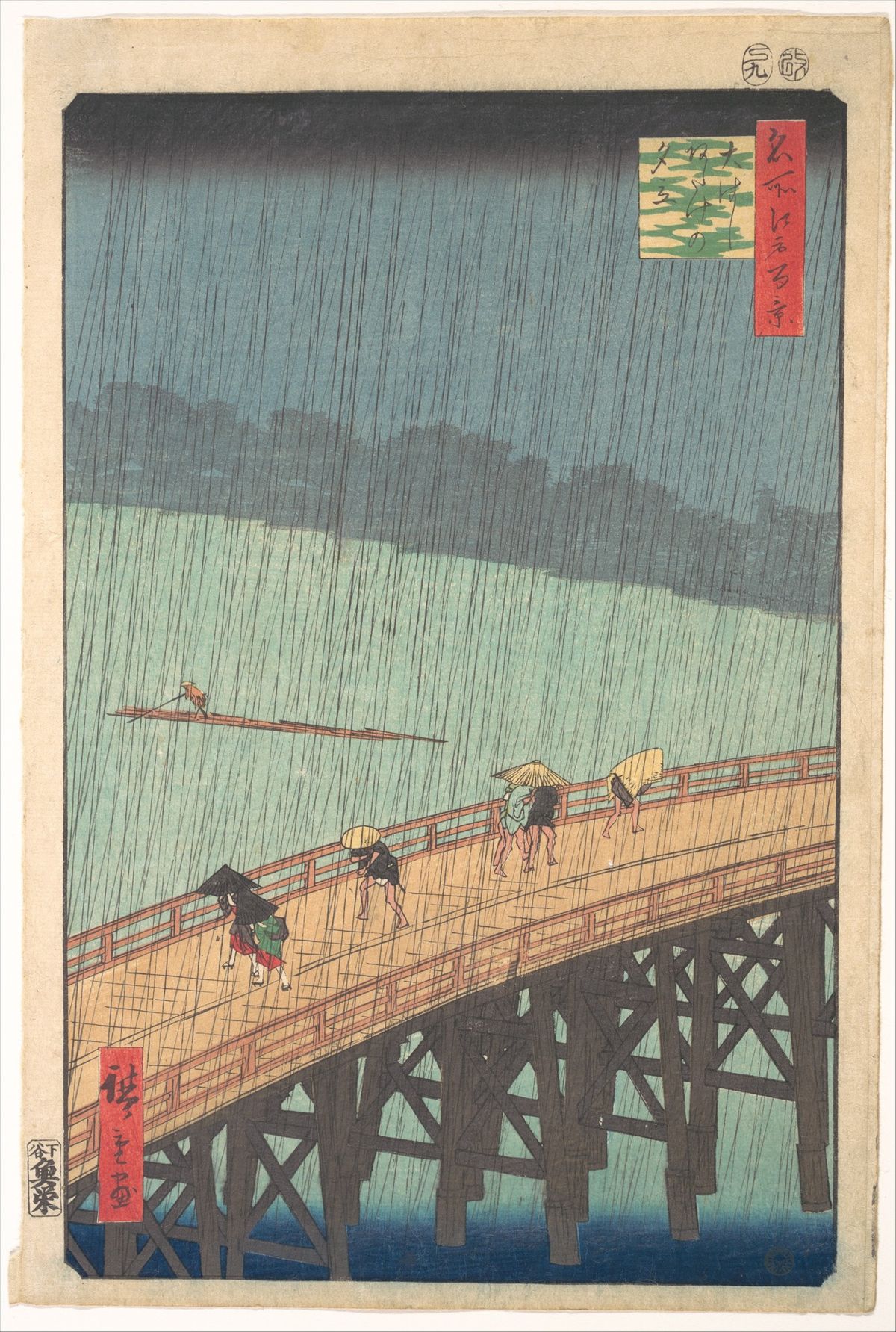
The rain falls almost the full height of Utagawa Hiroshige’s Sudden Shower over Shin-Ōhashi Bridge and Atake. Fine dark lines cross the river, the bridge and the people hurrying over it. They do more than tell us the weather. They hold the different distances together on one sheet of paper.
Made in 1857 for One Hundred Famous Views of Edo, the color woodblock print offers a view of the city now known as Tokyo. Yet the bridge is only part of what makes the image memorable. The picture is organized around a passing condition: being caught in a shower while trying to get somewhere.
A bridge that moves through the frame
The bridge cuts upward across the lower part of the print. Its supports drop toward the bottom edge, while the small figures bend beneath their coverings. Their separate gestures interrupt the long line of the crossing. Behind them, the far bank is much less distinct.
Look at the difference between the rain marks and the bridge. One pattern continues down through the image; the other gives the eye a firm diagonal route. That tension makes the scene feel active without needing a single central figure. Even the slender craft on the water has its own horizontal path through the downpour.
The dark band at the top presses down on a paler river. Hiroshige does not have to describe every building beyond it. Keeping that distance soft leaves the sharpest activity with the people and the structure nearest us.
Another way into the city
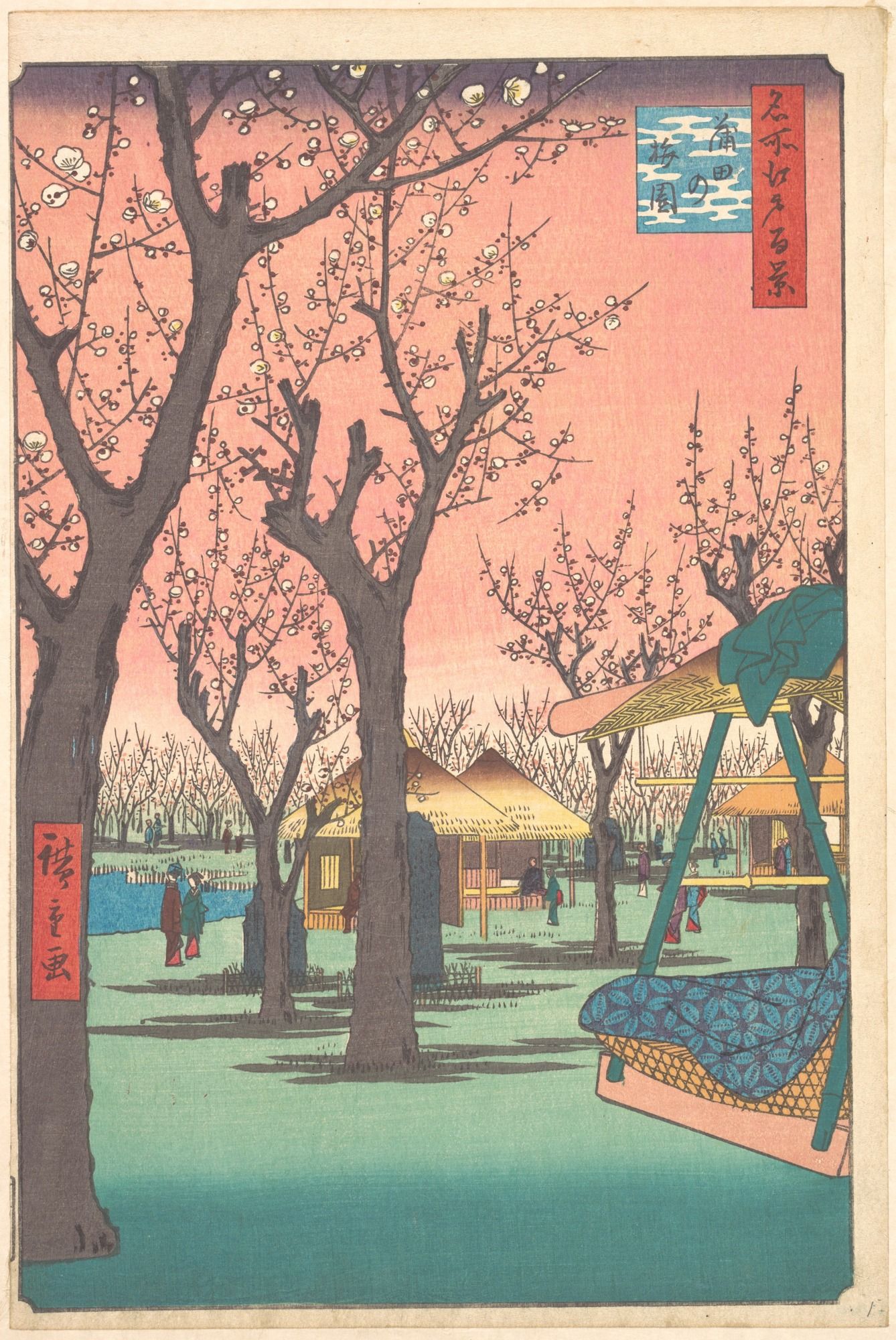
Plum Garden at Kamata, also dated 1857, changes the pace. Tree trunks rise close to the viewer, and the blossoms sit against a pink sky. A carrying chair enters from the right, partly cut off by the edge. Farther back, smaller figures occupy the garden.
Here, the large foreground shapes make the space beyond them feel accessible but not immediately available. You have to look past a trunk and around an object before settling into the scene. The near edge of the picture becomes part of the view rather than a clean boundary placed outside it.
Compare that with the bridge print. Rain reaches across its different layers, while the garden uses overlapping trees and the cropped chair to establish them. Both pictures give the viewer a position. Neither depends on presenting an unobstructed landmark from a politely distant spot.
Look at what stays out
It is tempting to treat a famous-view series as a list of places. These two prints are more interesting when read as choices about what a place is allowed to look like. A downpour can obscure a bank. A tree can block a garden. An object can enter without being shown in full.
Those interruptions are useful to notice in photographs, too. Before clearing every edge or waiting for empty space, ask what the obstruction contributes. It may be the detail that makes the view feel particular rather than interchangeable.