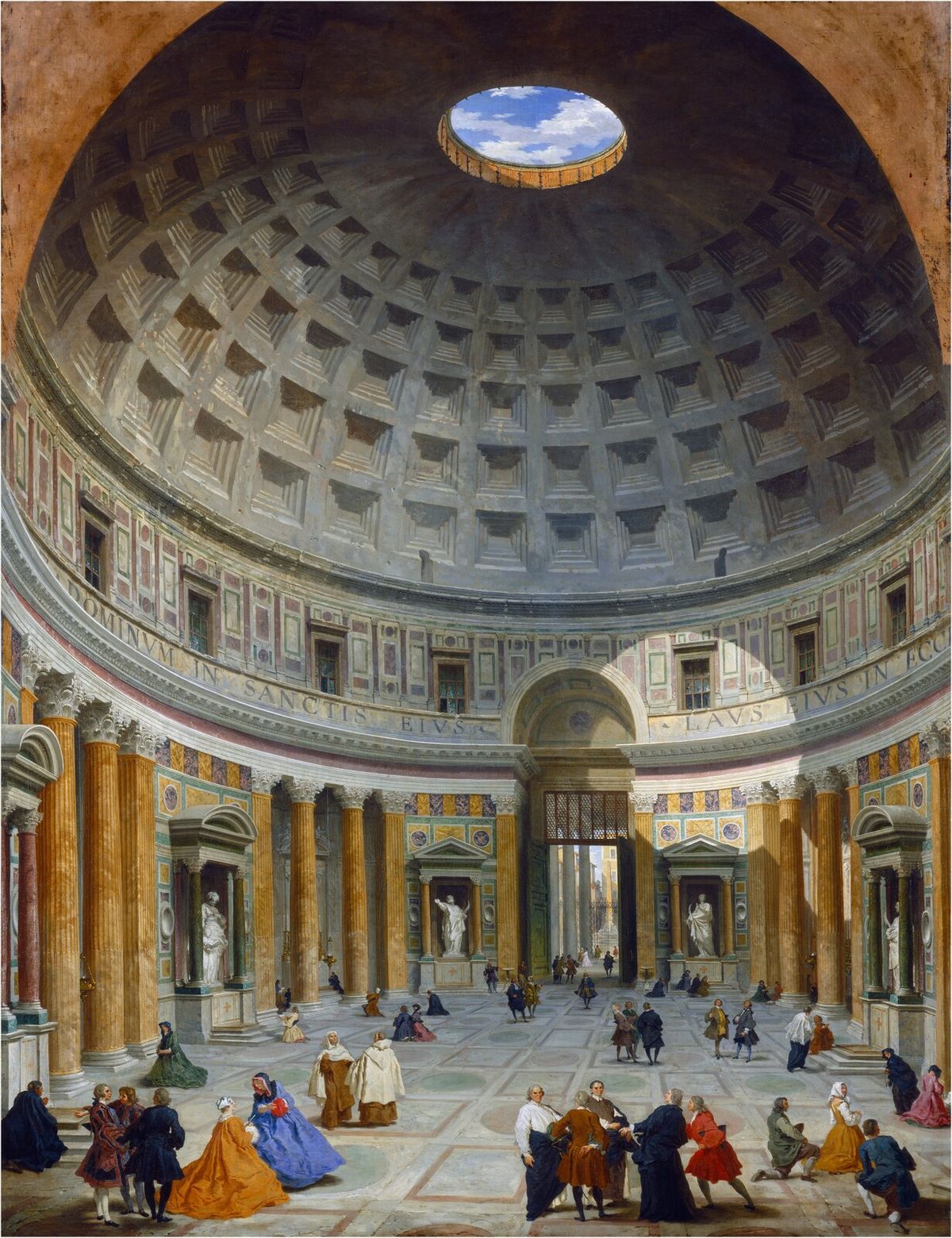
In Giovanni Paolo Panini’s Interior of the Pantheon, Rome, the people are small enough to make the building feel enormous. Some talk in groups; others stand apart or look upward. Above them, the dome takes up most of the canvas, with a circle of blue sky open at its crown.
The painting, dated about 1734, is held by the National Gallery of Art. Its apparently generous view is not a straightforward record from one fixed position. Panini adjusted the perspective to include more of the interior than a visitor could see from a single spot.
An image built around the room
Start at the floor. Its pattern leads toward the open doorway, giving the eye a route into the painting. Columns and niches then carry attention sideways around the wall. The repeated coffers in the dome bring that movement upward toward the oculus, the circular opening at the top.
The result is an image that seems to explain the room at once. It lets us connect the surface underfoot, the inhabited lower walls and the vault overhead. The small figures provide a scale against which all that architecture can be read.
There is also a world outside. Through the entrance, the painting shows daylight, people and part of the space beyond the building. The Pantheon is enclosed, but Panini has not made it feel detached from the city.
The room changes when the light changes
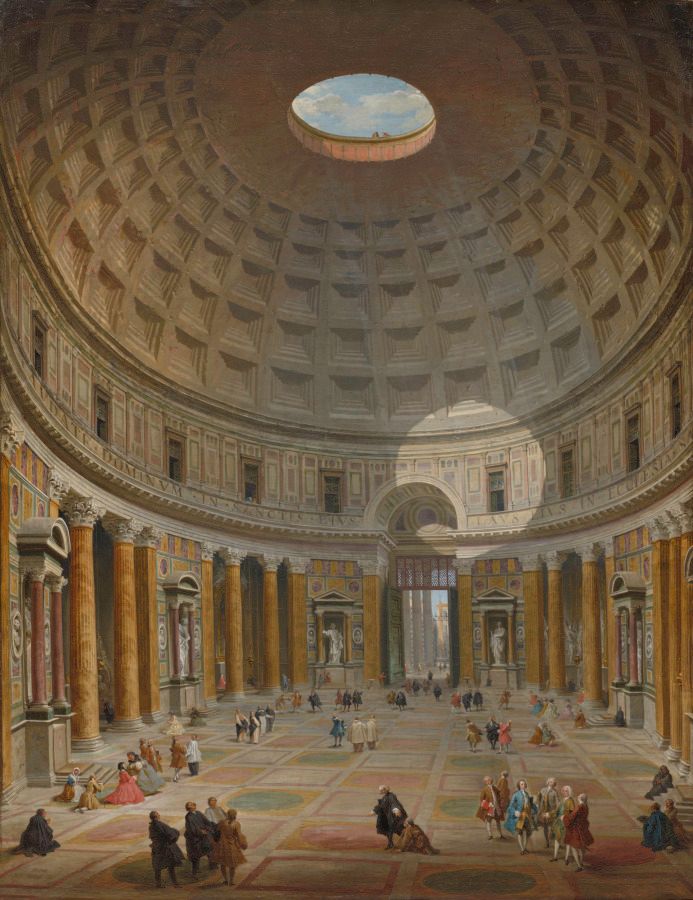
Panini returned to the subject. In the Cleveland Museum of Art’s version, dated 1747, a bright patch of light falls above the entrance. The opening in the roof is still visible, but the light it admits has become a second shape within the interior.
Compare that concentrated patch with the broad treatment of light in the earlier painting. The architecture offers a stable pattern of columns, panels and coffers; illumination picks out a temporary emphasis inside it. These are different paintings, not a measured sequence showing the sun’s movement. The comparison reveals artistic choices rather than establishing a time of day.
The figures matter here as well. Groups gather in different parts of the floor, leaving stretches of patterned surface between them. The open space makes the dome’s span easier to feel, while the activity prevents the building from becoming an empty specimen.
A monument with people inside
Built under Hadrian in the second century and consecrated as a Christian church in 609, the Pantheon had already carried different uses long before Panini painted it. His interiors include visitors and churchgoers rather than presenting antiquity as something entirely separate from everyday life.
That is a useful distinction when looking at architectural images. A photograph with no people may clarify a facade or a junction between materials. An inhabited image can explain scale, circulation or where people choose to pause. Each makes something easier to see and leaves something else out.
Panini’s adjusted view is a reminder to ask what an image is trying to give us. These canvases offer a persuasive sense of the Pantheon’s interior. They are historical interpretations of a building, not substitutes for a survey or evidence of its present condition.